
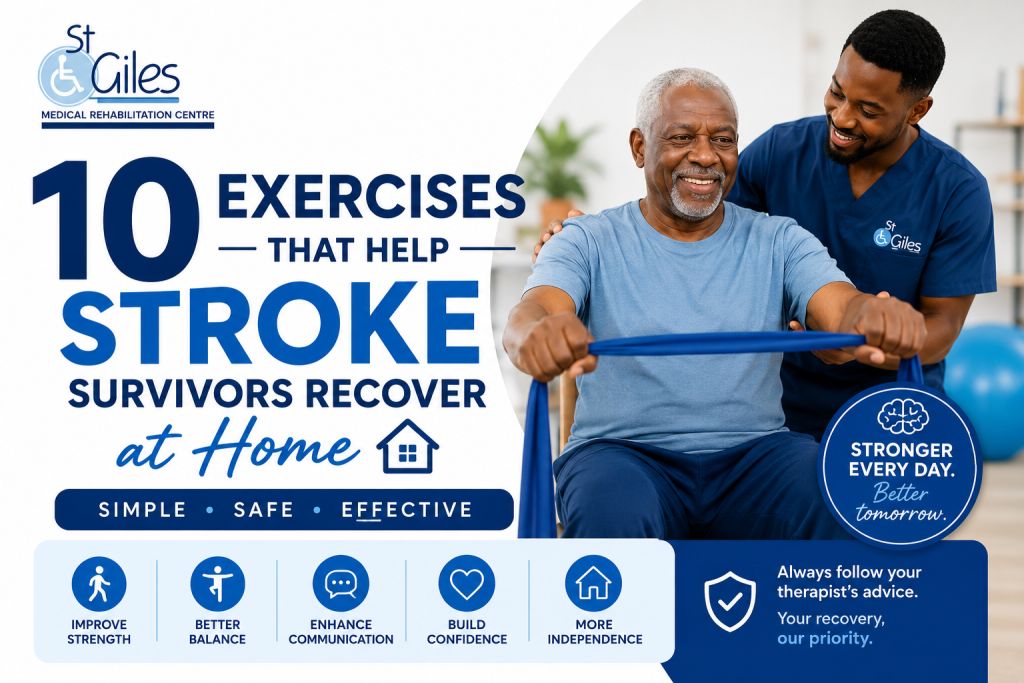
Recovering from a stroke is a journey that requires patience, consistency and the right support. While rehabilitation sessions with healthcare professionals are essential, continuing your exercises at home can play a significant role in improving strength, balance, mobility and confidence.
These exercises are commonly used during stroke rehabilitation. However, every person’s recovery is different. Always consult your physiotherapist or rehabilitation team before beginning any home exercise programme.
Why Home Exercises Matter
Regular exercise after a stroke can help:
- Improve muscle strength
- Increase flexibility
- Improve balance and coordination
- Reduce stiffness
- Improve walking ability
- Increase independence in daily activities
- Lower the risk of falls
- Build confidence during recovery
Even small improvements can make a meaningful difference over time.
1. Shoulder Rolls
Many stroke survivors experience stiffness in the shoulders due to reduced movement.
How to do it
- Sit comfortably.
- Slowly roll both shoulders forward 10 times.
- Repeat by rolling backwards 10 times.
Benefits
- Improves shoulder mobility
- Reduces stiffness
- Encourages better posture
2. Seated Knee Extensions
This exercise helps strengthen the thigh muscles used for standing and walking.
How to do it
- Sit in a sturdy chair.
- Slowly straighten one knee.
- Hold for three seconds.
- Lower slowly.
- Repeat 10 times on each leg.
Benefits
- Improves leg strength
- Supports safer standing
- Improves walking ability
3. Ankle Pumps
Ankle movement helps improve circulation and flexibility.
How to do it
- Sit or lie comfortably.
- Point your toes away.
- Pull them back towards you.
- Repeat 15–20 times.
Benefits
- Improves circulation
- Reduces swelling
- Improves ankle mobility
4. Sit-to-Stand Practice
Standing up safely is one of the most important functional movements after a stroke.
How to do it
- Sit in a stable chair.
- Lean slightly forward.
- Push through your legs to stand.
- Slowly sit back down.
Repeat 5–10 times if safe.
Benefits
- Builds leg strength
- Improves balance
- Increases independence
5. Weight Shifting
Weight shifting helps prepare for walking.
How to do it
- Stand while holding onto a stable surface.
- Slowly shift your weight from one leg to the other.
- Repeat for one minute.
Benefits
- Improves balance
- Improves confidence while standing
- Prepares for walking
6. Heel Raises
How to do it
- Hold onto a countertop or chair.
- Slowly rise onto your toes.
- Hold for two seconds.
- Lower gently.
Repeat 10–15 times.
Benefits
- Strengthens calf muscles
- Improves balance
- Supports walking
7. Finger Opening and Closing
Fine hand movements are often affected after a stroke.
How to do it
- Open your hand as wide as possible.
- Slowly close it into a gentle fist.
- Repeat 15 times.
If movement is limited, use your unaffected hand to assist.
Benefits
- Improves hand mobility
- Reduces stiffness
- Supports everyday tasks
8. Reaching Exercises
How to do it
- Sit upright.
- Place lightweight objects on a table.
- Reach forward and move them from one side to another.
Benefits
- Improves coordination
- Encourages arm movement
- Develops functional reach
9. Marching While Standing
Only perform this exercise if advised by your therapist.
How to do it
- Hold onto a sturdy support.
- Lift one knee.
- Lower it.
- Repeat with the other leg.
Continue for 30–60 seconds.
Benefits
- Improves balance
- Strengthens hip muscles
- Builds walking confidence
10. Walking Practice
Walking is one of the most effective rehabilitation exercises when appropriate.
Tips
- Use prescribed mobility aids if needed.
- Walk on flat, safe surfaces.
- Start with short distances.
- Increase gradually.
Benefits
- Improves endurance
- Strengthens muscles
- Promotes independence
Safety Tips
Before exercising:
- Wear supportive footwear.
- Exercise in a clutter-free area.
- Keep a sturdy chair or support nearby.
- Stop if you feel dizzy, experience chest pain or severe discomfort.
- Stay hydrated.
- Never force painful movements.
Always follow the guidance of your rehabilitation team.
How Often Should Stroke Survivors Exercise?
Consistency is more important than intensity.
Many rehabilitation programmes recommend:
- 20 to 30 minutes of exercise most days of the week
- Breaking exercises into shorter sessions if needed
- Gradually increasing activity as strength improves
Your rehabilitation team will recommend the most appropriate programme for your individual needs.
When Should You Seek Professional Help?
Contact your healthcare provider if you experience:
- New weakness
- Severe pain
- Loss of balance
- Frequent falls
- Difficulty swallowing
- Sudden speech problems
- Any symptoms similar to your original stroke
Never ignore warning signs.
Rehabilitation Doesn’t End at Home
Home exercises are most effective when combined with professional rehabilitation.
At St Giles Medical Rehabilitation Centre, our multidisciplinary team provides personalised stroke rehabilitation programmes designed to help individuals regain independence and improve their quality of life.
Our services include:
- Physiotherapy
- Occupational Therapy
- Speech & Language Therapy
- Hydrotherapy
- Psychological Support
- Social Work Services
- Mobility Assessments and Assistive Devices
Recovery takes time, but with consistent therapy, support and determination, meaningful progress is possible.
Read Next
Continue learning with our complete guide:
Stroke Rehabilitation: A Complete Guide to Recovery After a Stroke
You may also be interested in:
- Understanding Dystonia: Symptoms, Causes & Treatment
- Choosing the Right Mobility Aid: Walkers, Canes & Wheelchairs
- Preventing Falls at Home After a Stroke
- The Role of Occupational Therapy in Stroke Recovery
References
- World Stroke Organization. Stroke Recovery and Rehabilitation.
- American Stroke Association. Life After Stroke.
- National Institute of Neurological Disorders and Stroke (NINDS). Stroke Rehabilitation Information.
- NHS. Stroke Recovery.
- Mayo Clinic. Stroke Rehabilitation.
- Winstein CJ, et al. Guidelines for Adult Stroke Rehabilitation and Recovery. Stroke. 2016;47:e98-e169.
- Langhorne P, Bernhardt J, Kwakkel G. Stroke rehabilitation. Lancet. 2011;377(9778):1693-1702.