
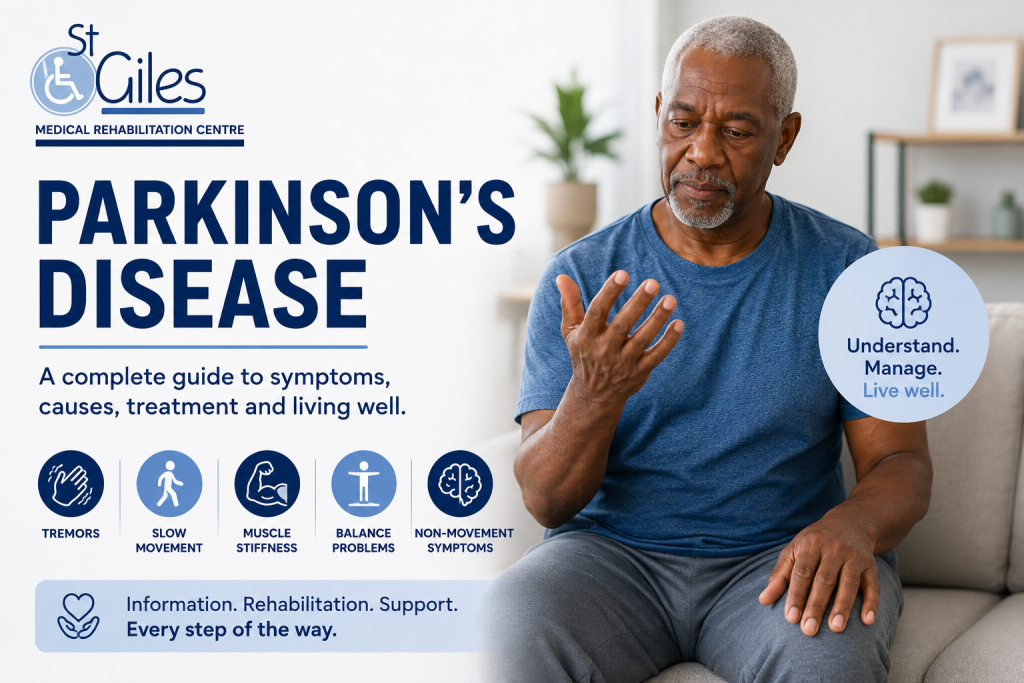
Understanding Parkinson’s Disease
Parkinson’s disease is a progressive neurological condition that primarily affects movement. It develops gradually, often beginning with subtle symptoms such as a slight tremor or stiffness before progressing over time.
Although there is currently no cure, many people with Parkinson’s disease continue to live active, fulfilling lives with the right combination of medication, rehabilitation, exercise and ongoing support.
At St Giles Medical Rehabilitation Centre, rehabilitation plays an important role in helping individuals maintain mobility, independence and quality of life throughout their Parkinson’s journey.
What Is Parkinson’s Disease?
Parkinson’s disease is a disorder of the nervous system caused by the gradual loss of nerve cells in a part of the brain called the substantia nigra.
These nerve cells produce dopamine, a chemical messenger that helps control smooth, coordinated movement. As dopamine levels decrease, movement becomes slower, muscles become stiffer, and balance and coordination may be affected.
Parkinson’s disease is progressive, meaning symptoms gradually change over time. However, the rate of progression varies from person to person.
What Causes Parkinson’s Disease?
The exact cause of Parkinson’s disease remains unknown.
Researchers believe it results from a combination of genetic and environmental factors.
Possible contributing factors include:
- Increasing age
- Family history of Parkinson’s disease
- Certain genetic mutations
- Long-term exposure to some environmental toxins
- Previous head injuries (in some cases)
Most people diagnosed with Parkinson’s disease have no clear family history.
Common Symptoms
Symptoms usually develop gradually and often begin on one side of the body before affecting both sides.
Movement Symptoms
- Tremors, especially at rest
- Muscle stiffness (rigidity)
- Slowness of movement (bradykinesia)
- Difficulty walking
- Poor balance
- Reduced arm swing while walking
- Shuffling gait
- Smaller handwriting (micrographia)
Non-Movement Symptoms
Parkinson’s affects more than movement.
Some people experience:
- Depression
- Anxiety
- Sleep disturbances
- Constipation
- Fatigue
- Reduced sense of smell
- Memory and thinking difficulties
- Soft or quiet speech
- Difficulty swallowing
Stages of Parkinson’s Disease
Symptoms often progress gradually.
Although every individual is different, Parkinson’s generally progresses through five stages:
Stage 1
- Mild symptoms
- Usually affects one side of the body
- Daily activities remain largely unaffected
Stage 2
- Symptoms affect both sides
- Walking may become slower
- Muscle stiffness increases
Stage 3
- Balance problems become more noticeable
- Falls become more likely
- Most people remain independent
Stage 4
- Walking often requires assistance
- Daily activities become more challenging
Stage 5
- Significant mobility limitations
- Full-time assistance may be required
Not everyone progresses through these stages at the same pace.
How Is Parkinson’s Disease Diagnosed?
There is currently no single test for Parkinson’s disease.
Doctors diagnose Parkinson’s by reviewing:
- Medical history
- Symptoms
- Physical examination
- Movement assessment
- Neurological examination
Brain imaging may sometimes be used to rule out other conditions.
Treatment Options
Although Parkinson’s cannot currently be cured, treatment can effectively manage symptoms.
Treatment may include:
- Medication to increase dopamine activity
- Regular exercise
- Physiotherapy
- Occupational therapy
- Speech and language therapy
- Healthy lifestyle changes
- In selected cases, surgery such as Deep Brain Stimulation (DBS)
Treatment plans are tailored to each individual.
Why Rehabilitation Is Essential
Medication helps control symptoms, but rehabilitation helps people maintain independence.
Research shows that regular rehabilitation can improve:
- Walking
- Balance
- Strength
- Flexibility
- Confidence
- Communication
- Daily living skills
Early rehabilitation often leads to better long-term outcomes.
How St Giles Supports People Living with Parkinson’s Disease
Physiotherapy
Physiotherapy focuses on improving movement and reducing stiffness.
Treatment may include:
- Walking training
- Balance exercises
- Stretching
- Strengthening exercises
- Posture correction
- Fall prevention strategies
Occupational Therapy
Occupational therapists help people remain independent in everyday life.
Support may include:
- Dressing
- Eating
- Writing
- Household activities
- Workplace adaptations
- Adaptive equipment training
- Energy conservation techniques
Speech & Language Therapy
Many people with Parkinson’s develop changes in speech and swallowing.
Speech therapists can help improve:
- Voice volume
- Speech clarity
- Swallowing safety
- Communication confidence
Hydrotherapy
Warm-water therapy allows gentle movement while reducing stress on joints and muscles.
Benefits include:
- Improved flexibility
- Better balance
- Reduced muscle stiffness
- Increased confidence during movement
Psychology
Living with Parkinson’s can be emotionally challenging.
Psychological support helps individuals and families cope with:
- Anxiety
- Depression
- Stress
- Adjustment to diagnosis
Social Work
Social workers assist families with:
- Community resources
- Disability support
- Care planning
- Family education
- Accessing available services
Living Well with Parkinson’s Disease
Although Parkinson’s is progressive, many people continue to lead meaningful and active lives.
Helpful lifestyle habits include:
- Exercising regularly
- Taking medication as prescribed
- Maintaining social connections
- Eating a balanced diet
- Prioritising sleep
- Managing stress
- Attending rehabilitation appointments consistently
Small daily habits can make a significant difference over time.
Frequently Asked Questions
Is Parkinson’s disease curable?
There is currently no cure, but treatments can effectively manage symptoms and improve quality of life.
Does everyone with Parkinson’s have tremors?
No. While tremors are common, some people mainly experience stiffness or slowed movement.
Can exercise slow the progression of Parkinson’s?
Exercise cannot cure Parkinson’s, but research suggests regular physical activity may help maintain mobility, improve function and reduce disability.
Can younger people develop Parkinson’s disease?
Yes. Although it most commonly affects older adults, younger people can also develop Parkinson’s disease.
Is Parkinson’s disease hereditary?
Most cases are not directly inherited, although genetics may contribute in some individuals.
How St Giles Can Help
Living with Parkinson’s disease can present daily challenges, but you don’t have to face them alone.
At St Giles Medical Rehabilitation Centre, our multidisciplinary rehabilitation team provides personalised care to help individuals maintain independence, mobility and confidence.
Our rehabilitation services include:
- Physiotherapy
- Occupational Therapy
- Speech & Language Therapy
- Hydrotherapy
- Psychological Support
- Social Work Services
- Mobility Assessments and Assistive Devices
Every rehabilitation programme is tailored to each person’s needs, helping them continue doing the things that matter most.
Related Articles
You may also be interested in:
- Stroke Rehabilitation: A Complete Guide to Recovery After a Stroke
- 10 Exercises That Help Stroke Survivors Recover at Home
- Understanding Dystonia: Symptoms, Causes & Treatment
- Choosing the Right Mobility Aid: Walkers, Canes & Wheelchairs
- Preventing Falls at Home: Tips for Older Adults
References
- World Health Organization (WHO). Parkinson Disease. https://www.who.int
- Parkinson’s Foundation. Understanding Parkinson’s. https://www.parkinson.org
- National Institute of Neurological Disorders and Stroke (NINDS). Parkinson’s Disease Information Page. https://www.ninds.nih.gov
- NHS. Parkinson’s Disease. https://www.nhs.uk/conditions/parkinsons-disease/
- Mayo Clinic. Parkinson’s Disease: Symptoms and Causes. https://www.mayoclinic.org
- National Institute for Health and Care Excellence (NICE). Parkinson’s Disease in Adults: Diagnosis and Management. NG71.
- Bloem BR, et al. Parkinson’s disease. Lancet. 2021;397(10291):2284-2303.