
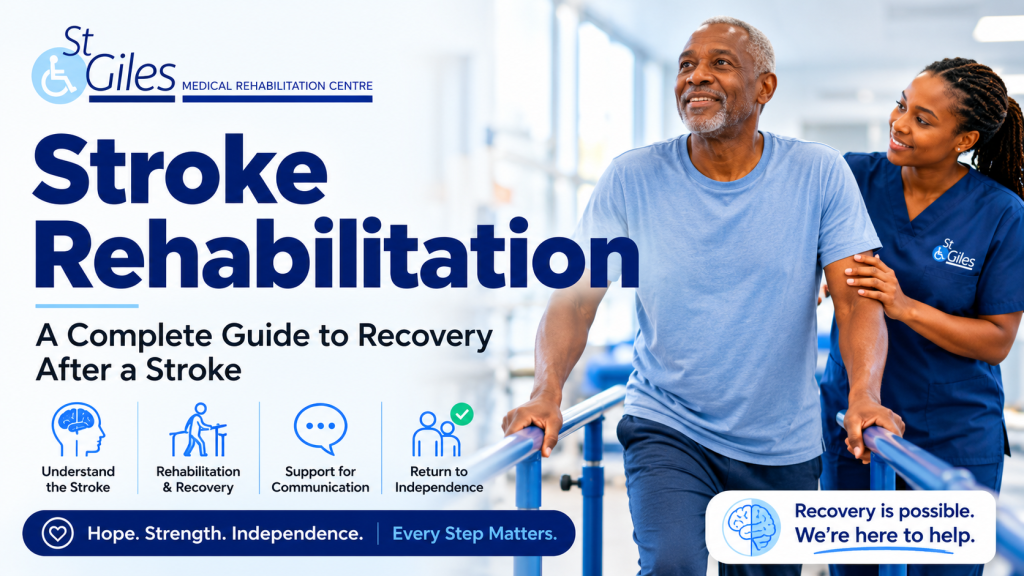
A stroke can change a person’s life in a matter of minutes. It may affect the ability to walk, speak, swallow, think, or carry out everyday activities independently. However, a stroke does not have to mean the end of an active and fulfilling life.
With early intervention, specialist rehabilitation and ongoing support, many stroke survivors make remarkable progress. Rehabilitation helps people regain lost abilities, adapt to new challenges and improve their quality of life.
At St Giles Medical Rehabilitation Centre, stroke rehabilitation is delivered through a multidisciplinary team that works together to support every stage of recovery.
What Is a Stroke?
A stroke occurs when the blood supply to part of the brain is interrupted or when a blood vessel in the brain bursts. Without oxygen and nutrients, brain cells begin to die within minutes.
Because different areas of the brain control different functions, the effects of a stroke vary from person to person.
Some people experience only mild weakness, while others may lose movement, speech or memory.
Types of Stroke
Ischemic Stroke
The most common type, accounting for approximately 85% of all strokes.
It occurs when a blood clot blocks an artery supplying blood to the brain.
Haemorrhagic Stroke
Occurs when a blood vessel in the brain ruptures and causes bleeding.
Although less common, haemorrhagic strokes are often more severe.
Transient Ischemic Attack (TIA)
Sometimes called a “mini-stroke.”
Symptoms resolve within 24 hours, but a TIA is an important warning sign that a full stroke may occur if treatment is not sought.
Common Signs of a Stroke
Recognising stroke symptoms quickly can save lives.
Remember the acronym FAST:
F – Face drooping
One side of the face may droop or feel numb.
A – Arm weakness
One arm may become weak or difficult to lift.
S – Speech difficulty
Speech may become slurred or difficult to understand.
T – Time to call emergency services
Immediate medical treatment greatly improves outcomes.
Other symptoms may include:
- Sudden confusion
- Vision problems
- Loss of balance
- Severe headache
- Difficulty walking
- Numbness on one side of the body
What Happens After a Stroke?
Every stroke is different.
Some people recover quickly, while others require months or even years of rehabilitation.
Common challenges include:
- Difficulty walking
- Weakness or paralysis
- Loss of balance
- Muscle stiffness (spasticity)
- Difficulty speaking
- Difficulty swallowing
- Memory problems
- Fatigue
- Depression and anxiety
What Is Stroke Rehabilitation?
Stroke rehabilitation is a personalised programme designed to help survivors recover as much function and independence as possible.
Rehabilitation focuses on:
- Improving movement
- Restoring communication
- Relearning everyday activities
- Increasing independence
- Preventing complications
- Improving emotional wellbeing
Recovery often continues long after a person leaves hospital.
Why Early Rehabilitation Matters
Research consistently shows that rehabilitation started as early as medically safe leads to better outcomes.
Early rehabilitation can:
- Improve mobility
- Reduce muscle stiffness
- Prevent pressure sores
- Reduce complications
- Improve confidence
- Increase independence
Recovery does not stop after the first few weeks. Many stroke survivors continue making progress months and even years later.
Rehabilitation Services at St Giles
Physiotherapy
Physiotherapists help stroke survivors regain strength, balance and movement.
Treatment may include:
- Walking training
- Balance exercises
- Strengthening exercises
- Range-of-motion exercises
- Gait retraining
- Spasticity management
The goal is to improve safe movement and reduce the risk of falls.
Occupational Therapy
Occupational therapists help people regain independence in everyday life.
This includes:
- Dressing
- Bathing
- Eating
- Writing
- Cooking
- Returning to work
- Home adaptations
- Adaptive equipment training
Speech and Language Therapy
A stroke may affect communication or swallowing.
Speech therapists assist with:
- Speech clarity
- Language understanding
- Reading and writing
- Memory strategies
- Safe swallowing assessments
- Communication techniques
Hydrotherapy
Warm-water therapy allows patients to move more comfortably while reducing pressure on painful joints and weak muscles.
Benefits include:
- Improved mobility
- Better balance
- Reduced muscle stiffness
- Increased confidence during movement
Psychological Support
Many stroke survivors experience:
- Anxiety
- Depression
- Frustration
- Loss of confidence
Psychological support helps patients and families adjust emotionally throughout recovery.
Social Work Support
Recovery extends beyond the hospital.
Social workers help families with:
- Community resources
- Care planning
- Family support
- Disability assistance
- Reintegration into everyday life
Can Someone Fully Recover from a Stroke?
Recovery varies depending on:
- The type of stroke
- Which part of the brain was affected
- How quickly treatment began
- Age and overall health
- Participation in rehabilitation
Many people regain significant independence, while others may continue living with some long-term disabilities.
The important thing is that recovery is often possible long after the stroke itself.
Tips for Stroke Recovery at Home
Patients and caregivers can support recovery by:
- Attending rehabilitation sessions consistently
- Following prescribed exercises
- Staying physically active
- Eating a healthy diet
- Taking medications as directed
- Preventing falls at home
- Staying socially connected
- Celebrating small improvements
Recovery is a journey, not a race.
Frequently Asked Questions
Can stroke survivors walk again?
Many can. Physiotherapy plays a key role in improving strength, balance and walking ability. Recovery depends on the severity of the stroke and consistent rehabilitation.
How long does stroke rehabilitation take?
Recovery varies widely. Some people improve within weeks, while others continue making progress over months or years.
Is stroke rehabilitation painful?
Exercises can be challenging, but rehabilitation should not cause severe pain. Therapists adjust treatment according to each patient’s abilities.
Can younger people have strokes?
Yes. Although more common in older adults, strokes can occur at any age.
Does rehabilitation still help years after a stroke?
Yes. Many people continue to improve long after the initial event with the right therapy and ongoing practice.
How St Giles Can Help
At St Giles Medical Rehabilitation Centre, our multidisciplinary rehabilitation team works with stroke survivors to improve mobility, communication, independence and quality of life.
Our rehabilitation services include:
- Physiotherapy
- Occupational Therapy
- Speech & Language Therapy
- Hydrotherapy
- Psychological Support
- Social Work Services
- Mobility Aids and Assistive Devices
Every rehabilitation programme is tailored to the individual’s needs and recovery goals.
If you or a loved one is recovering from a stroke, our team is here to support every step of the journey.
References
- World Health Organization (WHO). Stroke, Cerebrovascular Accident. https://www.who.int
- American Stroke Association. About Stroke. https://www.stroke.org
- National Institute of Neurological Disorders and Stroke (NINDS). Stroke Information Page. https://www.ninds.nih.gov
- Mayo Clinic. Stroke: Symptoms and Causes. https://www.mayoclinic.org
- NHS. Stroke Overview. https://www.nhs.uk/conditions/stroke/
- American Heart Association. Guidelines for Adult Stroke Rehabilitation and Recovery. Stroke. 2016.
- Winstein CJ, et al. Guidelines for Adult Stroke Rehabilitation and Recovery. Stroke. 2016;47:e98-e169.