
For someone recovering from a stroke, living with a disability, managing a neurological condition, recovering from surgery, or simply experiencing changes in mobility with age, something as ordinary as getting out of bed, walking to the bathroom or moving around the home can become a significant challenge.
This is where mobility aids can make an enormous difference.
A wheelchair, walking frame or walking stick may look like a relatively simple piece of equipment. But to the person using it, it can represent something much bigger:
The ability to move. The confidence to participate. The dignity of doing more for yourself.
Mobility aids are not simply about getting someone from one place to another. When appropriately selected and used, they can form an important part of rehabilitation, independence and everyday life.
What Are Mobility Aids?
Mobility aids are devices designed to support people who have difficulty moving safely or independently.
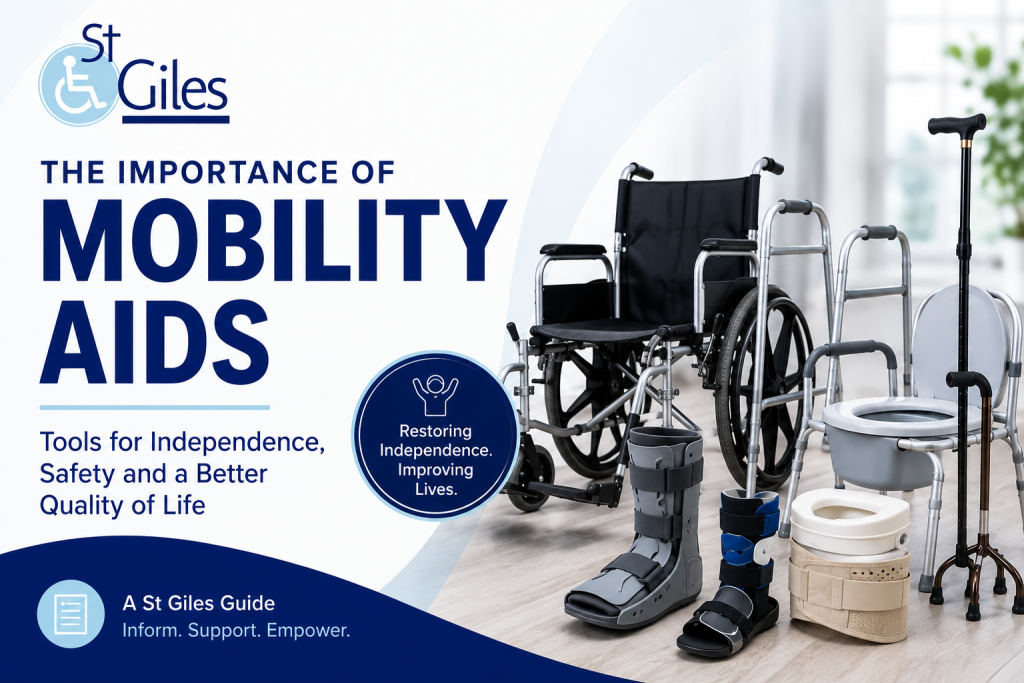
They can include:
- Wheelchairs
- Walking frames and wheeled walkers
- Walking sticks
- Orthopaedic boots
- Braces and supports
- Shower chairs
- Commodes
- Toilet raisers
- Other equipment that makes everyday movement and self-care safer and more manageable
Mobility and self-care aids may be required temporarily during recovery or become part of a person’s longer-term independence.
The World Health Organization (WHO) classifies products such as wheelchairs as assistive products: equipment intended to maintain or improve a person’s functioning and independence. Globally, more than 2.5 billion people are estimated to need one or more assistive products.
Why Mobility Matters
It is easy to underestimate the importance of movement until it becomes difficult.
Being able to move allows us to work, visit friends and family, go to school, attend appointments, participate in our communities and perform countless everyday activities.
For a person with reduced mobility, losing some of this ability can therefore affect much more than physical movement.
The WHO notes that assistive technology can support health, well-being, inclusion and participation, enabling people to live more independent and dignified lives and participate in education, employment and community life.
The goal of a mobility aid should therefore not simply be:
“Help this person walk.”
The bigger question is:
“How can we help this person participate in life as safely and independently as possible?”
1. Mobility Aids Can Support Independence
One of the greatest benefits of an appropriate mobility aid is the independence it can provide.
Consider someone who cannot safely walk a long distance without assistance.
Without appropriate support, that person may need another individual every time they want to move around.
With the right wheelchair or walking aid, they may be able to perform more activities independently.
For wheelchair users in particular, WHO describes wheelchairs as providing mobility, postural support and freedom to people who cannot walk or have difficulty walking, allowing greater participation in everyday activities.
Independence does not necessarily mean doing absolutely everything without assistance.
It means giving someone the greatest possible ability to make choices, participate and perform activities safely.
2. They Can Improve Safety
Mobility difficulties may increase the risk of losing balance or falling.
A correctly selected walking frame, walking stick or wheelchair can provide additional stability and support when appropriate for the individual’s needs.
Other assistive products address safety in different environments.
For example, a shower chair can allow someone who struggles to stand safely for extended periods to sit while bathing. A commode or toilet raiser may reduce the difficulty involved in sitting down and standing up during toileting.
These may seem like small adaptations.
For someone experiencing significant weakness, pain, balance problems or reduced mobility, however, they can make everyday routines considerably more manageable.
3. Mobility Aids Can Be Part of Rehabilitation
Using a mobility aid does not necessarily mean that someone has “given up” on recovery.
In many cases, the opposite is true.
Assistive products can form an important part of rehabilitation. WHO describes the provision of and training in assistive products as an integral component of rehabilitation, helping improve functioning, promote health and prevent complications.
During rehabilitation, a physiotherapist or other appropriate healthcare professional may recommend different levels of support as a person’s abilities change.
Someone might initially require a wheelchair, later progress to a walking frame, and eventually use a walking stick.
Another person may require long-term wheelchair use but work through rehabilitation to improve transfers, strength, posture, endurance and their ability to perform daily activities independently.
The mobility aid and rehabilitation can work together.
4. They Can Help People Participate in Everyday Life
Mobility is closely connected to participation.
Being able to move around more effectively may make it easier for someone to:
- Attend school
- Return to work
- Visit friends and relatives
- Attend healthcare appointments
- Participate in community activities
- Move around their home
- Take part in family life
For children who need wheelchairs, WHO highlights the importance of mobility for freedom, independence and inclusion in physical, emotional and social development. For older adults, appropriate wheelchairs can support continued participation in everyday activities and help maintain an active lifestyle.
This is why a mobility aid should not automatically be viewed as a symbol of limitation.
For many people, it is the tool that makes greater participation possible.
5. Mobility Aids Can Support Dignity
There is also a deeply human aspect to assistive equipment.
Imagine needing another person every time you want to use the bathroom.
Or being unable to join your family outside because walking that distance is no longer possible.
Or avoiding leaving home because you are worried about falling.
The appropriate equipment can give someone greater control over ordinary parts of life that most of us rarely think about.
WHO emphasises that assistive products can enable people to live healthy, productive, independent and dignified lives.
That dignity matters.
Choosing the Right Mobility Aid Matters
Not every wheelchair, walking frame, brace or walking stick is suitable for every person.
A mobility aid should ideally be selected according to factors such as:
- The person’s physical abilities
- Strength and balance
- Their condition or injury
- Body size and positioning requirements
- How frequently the equipment will be used
- Whether assistance from a caregiver is available
- The environment in which it will be used
- Whether the need is temporary or long-term
For wheelchairs specifically, WHO recommends an individual process involving assessment, appropriate selection, fitting, training and follow-up by trained personnel.
An inappropriate device may be uncomfortable, difficult to use or unsuitable for the person’s environment and physical needs.
This is why professional guidance can be valuable, particularly for people undergoing rehabilitation or living with significant mobility limitations.
When Should You Consider a Mobility Aid?
A healthcare professional may recommend an assistive device when someone experiences persistent difficulty with activities such as:
- Walking safely
- Maintaining balance
- Standing for extended periods
- Getting in or out of a chair
- Using the bathroom independently
- Bathing safely
- Moving around after surgery or injury
- Managing weakness caused by neurological or musculoskeletal conditions
People recovering from stroke, spinal cord injury, fractures or surgery — as well as people living with conditions affecting strength, balance or coordination — may require different forms of mobility assistance.
The appropriate solution will depend on the individual.
And Now for the Shameless Plug…
If you’ve reached this far, you probably understand why we take mobility equipment seriously.
St Giles Medical Rehabilitation Centre also stocks a range of mobility aids, orthopaedic supports and daily-living equipment.
Our available range includes:
Wheelchairs
- Economy Wheelchair
- Detachable Wheelchair
- Children’s Detachable Wheelchair
Walking & Mobility Support
- Walking Frame
- Walking Frame with Wheels
- Walking Stick
- Folding Walking Stick
- Castor Wheels
Bathroom & Daily-Living Support
- Commode
- Commode with Wheels
- Shower Chair
- Toilet Raiser
- Bed Pan
Orthopaedic Supports
- Ortho Boot
- Shoulder Brace
- Thoracolumbar Corset
- Lumbar Corset
- Ankle Brace
- Ankle Support
If you are unsure which product is appropriate for you or a family member, speak to the St Giles team about your needs.
Because the objective isn’t simply to provide equipment.
It’s to help people move more safely, participate more fully and live with greater independence.
Contact St Giles Medical Rehabilitation Centre
📍 8 Drummond Chaplin, Milton Park, Harare
📞 +263 78 855 9159
📞 +263 71 480 7233
🌐 stgileszim.co.zw
References
- World Health Organization. Assistive technology – Fact sheet. 2024.
- World Health Organization. Assistive technology.
- World Health Organization. Wheelchair provision guidelines. 2023.
- World Health Organization. Strengthening access to appropriate wheelchairs.
- World Health Organization. Assistive Technology and Rehabilitation.